Introduction: The Battery Choice That Can Make or Break Your Solar ROI
In today’s solar industry, the conversation is no longer just about panels and inverters. For EPC contractors, project developers, and commercial buyers, energy storage is now the core driver of project profitability.
And within every solar storage system, one decision has a disproportionate impact on long-term returns:
Choosing between lithium batteries and lead-acid batteries.
At first glance, this may appear to be a simple cost comparison. Lead-acid batteries are cheaper upfront, while lithium batteries require higher initial investment. However, for B2B decision-makers, this perspective is dangerously incomplete.
Because in real-world solar projects, the wrong battery choice doesn’t just increase costs—it creates compounding financial risks:
- Frequent battery replacements every 2–3 years
- Lower usable capacity reducing system output
- Higher O&M costs and manual maintenance
- Energy losses that directly reduce project revenue
In contrast, selecting the right battery technology can:
- Increase system efficiency by over 20%
- Extend project lifespan beyond 10 years
- Reduce total cost of ownership (TCO)
- Improve IRR and shorten payback periods
This is why the debate around lithium vs lead-acid batteries for solar is not just technical—it is fundamentally a financial decision.
In this guide, we break down the real differences between these two technologies from a commercial perspective—covering performance, cost, scalability, and ROI—so you can choose the best battery for your solar storage project.
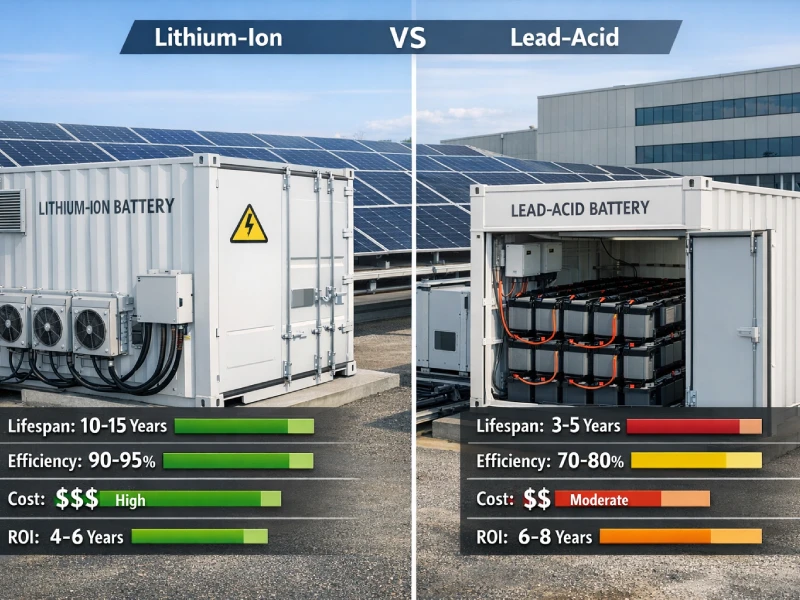
Quick Comparison: Lithium vs Lead-Acid Batteries at a Glance
For fast decision-making, here is a side-by-side solar battery comparison based on the metrics that matter most in commercial applications:
| Key Factor | Lithium Battery (LiFePO4) | Lead-Acid Battery |
|---|---|---|
| Cycle Life | 4,000 – 8,000 cycles | 300 – 1,500 cycles |
| Usable Capacity (DoD) | 80% – 95% | ~50% |
| System Efficiency | >95% | 70% – 85% |
| Maintenance | Minimal (automated BMS) | Frequent manual maintenance |
| Installation Space | Compact & modular | Large & heavy |
| Initial Investment | Higher | Lower |
| Lifetime Cost | Lower | Significantly higher |
While lead-acid batteries may appear attractive from a CAPEX perspective, lithium batteries clearly dominate in performance, efficiency, and lifecycle value.
But to understand why most commercial projects are shifting toward lithium, we need to examine how each technology performs in real solar applications.
Why Lithium Batteries Are Transforming Modern Solar Projects
Over the past decade, lithium battery technology—especially LiFePO4 (Lithium Iron Phosphate)—has rapidly become the standard for commercial solar battery solutions.
This shift is not driven by trend, but by measurable improvements in performance and economics.
1. High Efficiency = More Usable Energy
Lithium batteries offer round-trip efficiencies above 95%, meaning more of the stored solar energy is actually delivered to the load.
In comparison, lead-acid systems lose up to 30% of energy during storage cycles—directly reducing project revenue.
For EPCs, this translates into higher system output without increasing PV capacity.
2. Deep Discharge Capability Maximizes ROI
A key advantage of lithium batteries is their high depth of discharge (DoD), typically up to 90–95%.
This means:
- More usable energy per cycle
- Smaller battery bank required
- Lower cost per kWh over time
In contrast, lead-acid batteries are typically limited to 50% DoD, effectively doubling the required capacity for the same usable output.
3. Long Cycle Life Reduces Replacement Costs
Lithium batteries can deliver 4,000–8,000 cycles, equivalent to 10+ years of operation in most solar applications.
Lead-acid batteries, on the other hand, may require replacement every 2–4 years.
This is one of the biggest hidden costs in solar projects.
4. Smart Battery Management System (BMS)
Unlike lead-acid systems, lithium batteries are equipped with intelligent BMS (Battery Management Systems) that:
- Protect against overcharge and overheating
- Optimize performance in real time
- Enable remote monitoring and diagnostics
This significantly reduces operational risk and maintenance workload—critical for large-scale deployments.
5. Modular Design for Scalable Projects
Modern lithium battery systems are designed with modular architecture, allowing:
- Easy capacity expansion
- Flexible system design
- Faster installation
This makes them ideal for:
- Commercial & industrial solar projects
- Microgrids
- Energy storage expansion scenarios
Where Lead-Acid Batteries Still Fit (And Where They Don’t)
Despite the rapid adoption of lithium batteries, lead-acid technology has not completely disappeared. In certain niche scenarios, it still offers value.
When Lead-Acid Batteries May Be Suitable
- Projects with extremely limited upfront budget
- Backup systems with low cycling frequency
- Short-term or temporary installations
However, for Most Commercial Solar Projects…
Lead-acid batteries struggle to meet modern performance requirements due to:
- Short lifespan and frequent replacements
- High maintenance costs
- Low efficiency and energy losses
- Poor performance in high-temperature environments
For B2B buyers focused on long-term ROI, these limitations often outweigh the initial cost savings.
The Hidden Cost Problem: Why Upfront Price Is Misleading
One of the most common mistakes in battery selection is focusing solely on upfront cost.
While lead-acid batteries are cheaper initially, they introduce hidden costs that accumulate over time:
- Replacement costs (multiple cycles)
- Labor and maintenance expenses
- Energy losses reducing revenue
- System downtime during replacements
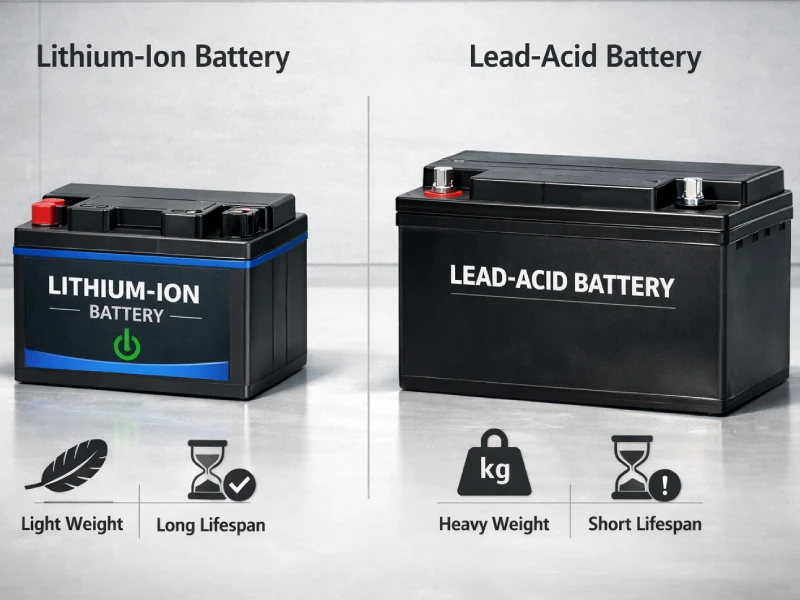
Lithium batteries, although more expensive upfront, deliver significantly lower total cost of ownership (TCO).
In the next section, we will break down a detailed lithium vs lead acid cost comparison to show which option truly delivers better financial returns.
Total Cost of Ownership (TCO): Which Battery Actually Saves More Over Time?
For commercial solar projects, the most critical question is not “Which battery is cheaper?” but rather:
“Which battery delivers the lowest cost per kWh over its lifetime?”
This is where Total Cost of Ownership (TCO) becomes the decisive metric in any serious lithium vs lead-acid batteries for solar evaluation.
Breaking Down the Real Cost Structure
To accurately compare lithium and lead-acid batteries, we must consider all cost components across the project lifecycle:
- Initial CAPEX: Battery purchase and installation
- Replacement Cost: Number of battery replacements over project life
- Operational & Maintenance (O&M): Labor, inspection, downtime
- Energy Loss Cost: Efficiency-related losses over time
- System Downtime Risk: Impact on revenue and operations
Ignoring any of these factors leads to a distorted investment decision.
10-Year Cost Comparison: Lithium vs Lead-Acid
Let’s model a simplified commercial solar storage scenario:
- Project duration: 10 years
- Daily cycling application (typical C&I load shifting)
- Same usable energy requirement
| Cost Category | Lithium Battery | Lead-Acid Battery |
|---|---|---|
| Initial Investment | Higher | Lower |
| Number of Replacements | 0–1 | 3–5 |
| Maintenance Cost | Low | High |
| Energy Loss Cost | Minimal | Significant |
| Total 10-Year Cost | Lowest | Highest |
In real-world deployments, lead-acid systems can end up costing 1.5x to 3x more than lithium systems over a 10-year period.
This is why forward-looking EPCs and developers are shifting toward lithium despite higher upfront costs.
Cost per kWh Delivered: The Metric That Matters
A more precise way to evaluate battery economics is to calculate:
Cost per kWh = Total Lifetime Cost ÷ Total Energy Delivered
Because lithium batteries:
- Have higher cycle life
- Allow deeper discharge (higher usable capacity)
- Operate with higher efficiency
They deliver significantly more usable energy over their lifetime.
Result: Even with higher CAPEX, lithium batteries achieve a much lower cost per kWh—making them the superior choice for commercial solar battery solutions.
Key Insight for B2B Buyers
If your project involves:
- Daily cycling (peak shaving, arbitrage)
- Long-term operation (5–10+ years)
- Revenue optimization (C&I or grid services)
Then lithium is not just a better option—it is the only financially viable option.
Performance Under Real-World Conditions: Where the Gap Widens
Lab specifications rarely reflect real operating environments. In actual solar deployments—especially in regions like Southeast Asia, the Middle East, and Africa—battery performance is heavily influenced by external conditions.
This is where the gap between lithium and lead-acid becomes even more pronounced.
High Temperature Performance
Temperature is one of the most critical factors affecting battery lifespan.
- Lead-acid batteries: Lifespan can be reduced by 50% for every 10°C increase above optimal temperature
- Lithium batteries: Much more stable, especially LiFePO4 chemistry
In hot climates, lead-acid batteries degrade rapidly, leading to:
- Frequent replacements
- Capacity loss
- Increased project risk
Lithium batteries, on the other hand, maintain consistent performance, making them ideal for solar battery systems in high-temperature regions.
Depth of Discharge (DoD) Impact on Usable Energy
In real projects, usable energy—not nominal capacity—determines system value.
- Lead-acid: ~50% usable capacity
- Lithium: up to 95% usable capacity
This means a 100 kWh lithium system can deliver nearly double the usable energy of a lead-acid system with the same nominal capacity.
Implication: Lower system size, lower installation cost, and higher ROI.
Charging Speed and Operational Flexibility
Lithium batteries support faster charging and discharging, enabling:
- Better response to peak demand
- Improved energy arbitrage opportunities
- Higher system utilization rates
Lead-acid batteries, in contrast, require slower charging to avoid damage—limiting operational flexibility.
Efficiency Loss and Revenue Impact
Efficiency differences directly translate into lost revenue:
- Lead-acid: up to 30% energy loss
- Lithium: <5% loss
For large-scale systems, this can represent thousands of dollars in lost energy value annually.
Installation, Space & System Design Considerations
Beyond performance and cost, battery selection significantly impacts system design, installation complexity, and scalability.
Footprint and Energy Density
Lithium batteries offer much higher energy density, meaning:
- Smaller physical footprint
- Reduced structural requirements
- Lower installation cost
Lead-acid systems require significantly more space, which can be a limiting factor in commercial installations.
Modular Design vs Fixed Systems
Modern lithium battery systems are designed with modular architecture:
- Plug-and-play expansion
- Flexible system sizing
- Reduced installation time
Lead-acid systems are typically:
- Less flexible
- More complex to scale
- Higher labor requirements
Scalability for Growing Energy Demand
For commercial projects, future expansion is often unavoidable.
Lithium systems allow easy capacity upgrades without:
- Replacing the entire system
- Reconfiguring infrastructure
This makes them ideal for:
- Industrial facilities
- Microgrids
- Energy storage-as-a-service (ESaaS) models
Safety Comparison: Risk Management in Commercial Projects
Safety is a non-negotiable factor in commercial solar installations. Battery-related risks can lead to:
- Operational shutdowns
- Regulatory issues
- Financial losses
Lithium Battery Safety (LiFePO4 Advantage)
LiFePO4 batteries are widely regarded as one of the safest lithium chemistries due to:
- Thermal stability
- Lower risk of thermal runaway
- Advanced BMS protection systems
Modern systems include:
- Real-time monitoring
- Automatic shutdown mechanisms
- Fault diagnostics
Lead-Acid Safety Risks
Lead-acid batteries present several inherent risks:
- Hydrogen gas emissions (explosion risk)
- Acid leakage and corrosion
- Ventilation requirements
These risks increase installation complexity and compliance requirements.
Compliance and Certification
Lithium battery systems typically comply with international standards such as:
- UN38.3 (transport safety)
- IEC certifications
- UL standards (for certain markets)
For EPC contractors, certified lithium systems reduce project approval risk and improve bankability.
Best Use Cases: When to Choose Lithium or Lead-Acid Batteries
After analyzing performance, cost, and real-world conditions, the decision between lithium and lead-acid batteries becomes clear when mapped to specific project scenarios.
Choose Lithium Batteries If Your Project Involves:
- Daily cycling applications (peak shaving, energy arbitrage)
- Commercial & industrial (C&I) solar systems
- High electricity price markets (e.g., Germany, EU)
- Long-term investment horizon (5–15 years)
- Limited installation space
- Scalable energy storage requirements
Conclusion: Lithium is the default choice for modern commercial solar battery solutions.
Lead-Acid May Still Be Considered If:
- Budget is extremely constrained
- System usage is infrequent (backup only)
- Project duration is short-term
However, even in these scenarios, decision-makers should carefully evaluate lifecycle cost risks before choosing lead-acid.
Germany Market Case Study: Energy Arbitrage with Lithium Batteries
Germany represents one of the most mature and financially optimized solar + storage markets globally. High electricity prices and strong grid dynamics make it an ideal case to demonstrate the real value of lithium batteries.
Market Background
- Average industrial electricity price: €0.25–€0.40 per kWh
- Peak vs off-peak price spread: €0.10–€0.20 per kWh
- High penetration of solar PV systems
This price volatility creates a strong opportunity for energy arbitrage—storing energy when prices are low and discharging when prices are high.
Sample Project Scenario
- System size: 100 kWh lithium battery
- Application: Daily charge/discharge (1 cycle/day)
- Price difference: €0.15 per kWh
- System efficiency: 95%
Annual Revenue Calculation
Daily profit:
100 kWh × €0.15 × 95% = €14.25
Annual profit:
€14.25 × 365 ≈ €5,200
10-year revenue:
≈ €52,000
Why Lead-Acid Fails in This Scenario
If we apply the same model to lead-acid batteries:
- Usable capacity reduced by ~50%
- Efficiency drops to ~75%
- Lifespan requires 3–5 replacements
Result:
- Lower annual revenue
- Higher replacement cost
- Reduced system uptime
Conclusion: Lead-acid batteries are economically unviable for energy arbitrage applications.
IRR Analysis: Why Lithium Delivers Superior Investment Returns
For commercial investors, Internal Rate of Return (IRR) is the ultimate decision metric.
Let’s compare simplified IRR outcomes for lithium vs lead-acid systems:
| Metric | Lithium Battery | Lead-Acid Battery |
|---|---|---|
| Initial Investment | Higher | Lower |
| Annual Revenue | High | Low |
| Maintenance Cost | Low | High |
| Replacement Frequency | Minimal | High |
| IRR (10-year) | 15% – 25% | <10% |
In high electricity price markets like Germany, lithium-based systems consistently achieve double-digit IRR, making them highly attractive for investors.
Lead-acid systems, by contrast, struggle to meet minimum investment thresholds.
How to Choose the Right Battery for Your Solar Project
Selecting the right battery requires aligning technical specifications with business objectives.
Key Decision Factors
- Project Type: Residential vs C&I vs utility-scale
- Usage Pattern: Backup vs daily cycling
- Electricity Pricing Model: Fixed vs dynamic tariffs
- Project Duration: Short-term vs long-term ROI
- Installation Constraints: Space, environment, scalability
For most commercial applications, lithium batteries provide the optimal balance of performance, scalability, and financial return.
Why Choose SOLARDYNA for Your Solar Battery Solutions
At SOLARDYNA, we understand that battery selection is not just about products—it is about delivering reliable, bankable energy solutions.
- High-performance lithium battery systems designed for commercial applications
- Advanced BMS technology for safety and efficiency
- Modular and scalable design for flexible deployment
- Full system integration support for EPCs and developers
- Compliance with international standards (IEC, UN38.3)
Whether you are developing a new project or upgrading an existing system, our engineering team can help you design the optimal solar battery solution.
👉 Get a Free Quote or Talk to Our Engineers Today.
FAQ: Lithium vs Lead-Acid Batteries for Solar
1. Are lithium batteries better than lead-acid for solar?
Yes, lithium batteries offer higher efficiency, longer lifespan, and lower total cost of ownership, making them ideal for most solar applications.
2. Why are lithium batteries more expensive upfront?
Lithium batteries use advanced materials and integrated BMS technology, but their longer lifespan and higher efficiency result in lower overall cost.
3. Can I replace lead-acid with lithium in an existing system?
Yes, but compatibility with inverters and system configuration must be evaluated.
4. Which battery is better for commercial solar projects?
Lithium batteries are the preferred choice due to their scalability, efficiency, and ROI advantages.
5. How long do lithium solar batteries last?
Typically 8–15 years, depending on usage and system design.
6. Are lithium batteries safe?
Yes, especially LiFePO4 batteries, which are among the safest lithium chemistries available.
7. What is the ROI of lithium vs lead-acid batteries?
Lithium batteries can deliver significantly higher ROI due to lower lifecycle costs and higher energy output.
8. Are lithium batteries suitable for hot climates?
Yes, lithium batteries perform much better than lead-acid in high-temperature environments.
Conclusion: The Future of Solar Storage Is Lithium
The comparison between lithium and lead-acid batteries ultimately comes down to one key factor: long-term value.
While lead-acid batteries may offer short-term savings, lithium batteries deliver superior performance, lower lifecycle costs, and higher returns—making them the clear choice for modern solar projects.
As global energy markets evolve and electricity price volatility increases, lithium-based energy storage systems will continue to play a critical role in maximizing solar investment returns.
👉 Ready to optimize your solar project? Contact SOLARDYNA today.
References
- International Renewable Energy Agency (IRENA). (2023). Electricity storage and renewables: Costs and markets.
- Lazard. (2023). Levelized cost of storage analysis.
- National Renewable Energy Laboratory (NREL). (2022). Battery storage for renewable energy systems.
- U.S. Department of Energy. (2023). Energy storage technology and cost analysis.
Maximize Your Solar ROI with the Right Battery Solution
Still deciding between lithium vs lead-acid batteries for solar? Our engineers help you design a high-performance battery energy storage system (BESS) tailored for your project — optimized for cost savings, efficiency, and long-term ROI.
✔ Optimized lithium battery solutions for commercial solar projects
✔ Fast response from experienced energy storage engineers
Or request a custom lithium battery quote for your solar project