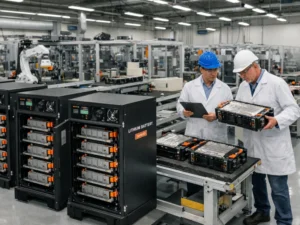
Reliable electricity remains one of the biggest challenges for businesses operating beyond the reach of conventional utility infrastructure. Whether supporting a telecommunications tower, a mining exploration camp, an agricultural irrigation system, or a remote research facility, uninterrupted power is essential for maintaining productivity, protecting critical equipment, and reducing operational risks. As diesel fuel prices continue to fluctuate and environmental regulations become more stringent, many organizations are replacing traditional generators with off grid remote solar solutions. A professionally engineered off grid remote solar system combines high-efficiency photovoltaic (PV) modules, advanced LiFePO4 battery storage, intelligent power conversion, and remote monitoring to deliver dependable, low-maintenance energy for decades. For EPC contractors, distributors, and procurement managers, selecting the right system architecture and manufacturing partner is just as important as choosing the right equipment.
Unlike residential solar installations, commercial off-grid projects require detailed engineering analysis, accurate load forecasting, long-term lifecycle planning, and equipment capable of operating in harsh environments. A poorly designed system can lead to battery degradation, unexpected downtime, oversized investments, or costly maintenance visits. Conversely, a properly designed solution minimizes operating expenses while improving energy independence and project reliability.
This comprehensive guide explores how modern off-grid solar technology addresses the unique challenges of remote commercial and industrial applications. You’ll learn the essential components of an off-grid system, key engineering considerations, battery selection strategies, cost factors, industry applications, and practical procurement advice for choosing a reliable manufacturing partner. Whether you are planning a new installation or evaluating suppliers for future projects, this guide will help you make informed, engineering-driven decisions.
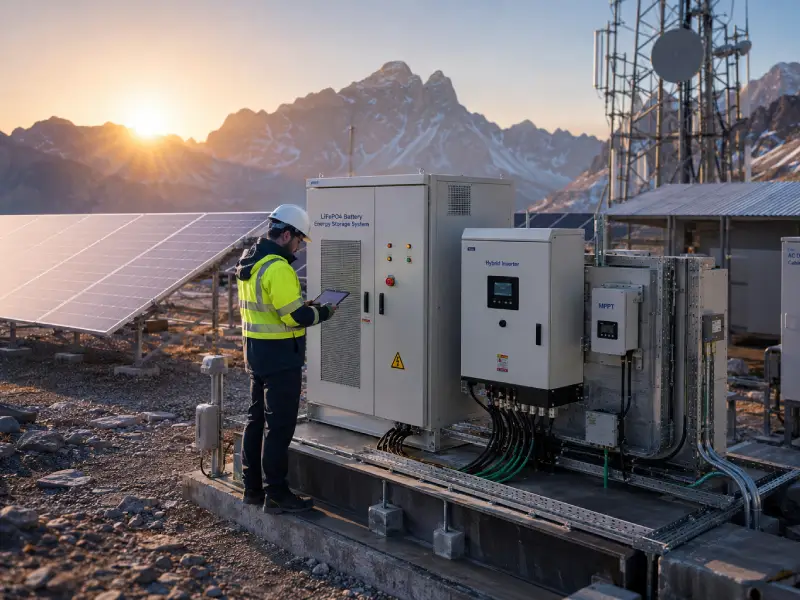
Why Reliable Power Has Become a Critical Challenge in Remote Areas
Despite significant advancements in global electrification, countless commercial and industrial operations continue to operate in locations where extending the utility grid is either technically impractical or economically unjustifiable. Remote mining sites, agricultural plantations, oil and gas facilities, mountain communication stations, islands, border security checkpoints, and disaster recovery centers all require dependable electricity to support daily operations. For many of these applications, connecting to the public grid may require hundreds of kilometers of transmission infrastructure, resulting in substantial capital investment and lengthy project timelines.
Historically, diesel generators have been the default solution for off-grid applications because they are relatively easy to deploy and capable of providing continuous power. However, this approach presents several long-term operational challenges. Fuel transportation to isolated locations often represents a significant portion of operating expenses, particularly in mountainous regions, islands, deserts, or areas with limited transportation infrastructure. Generator maintenance also requires skilled technicians, replacement parts, scheduled servicing, and unexpected repairs, all of which increase lifecycle costs and create operational uncertainty.
Furthermore, organizations worldwide are under increasing pressure to reduce carbon emissions, improve environmental performance, and meet corporate sustainability objectives. These factors have accelerated the adoption of renewable energy systems capable of delivering reliable electricity without continuous fuel consumption.
Modern off-grid solar technology has evolved far beyond simple solar panel installations. Today’s commercial systems integrate intelligent battery management, high-efficiency inverters, cloud-based monitoring platforms, and modular LiFePO4 battery storage capable of supporting demanding industrial loads while minimizing maintenance requirements.
Why Businesses Are Transitioning Away from Diesel
- Increasing diesel fuel and transportation costs
- High maintenance requirements for generators
- Stricter environmental regulations and ESG commitments
- Reduced risk of fuel theft and supply interruptions
- Lower total cost of ownership over the system lifecycle
- Improved operational reliability through intelligent energy management
- Scalable system architecture for future capacity expansion
For EPC contractors and engineering firms, the conversation has shifted from simply replacing generators to designing integrated energy systems that balance generation, storage, load management, and long-term operational efficiency. This engineering-first approach enables project owners to achieve lower operating costs while improving resilience against fuel price volatility and infrastructure limitations.
What Is an Off Grid Remote Solar System?
An off-grid remote solar system is a self-contained power generation and energy storage solution designed to operate independently of the public electricity grid. Unlike grid-connected photovoltaic systems, off-grid installations must generate, store, and manage all required electricity locally. This makes system design considerably more complex because every component must be carefully sized to ensure reliable operation during nighttime, cloudy weather, and seasonal variations in solar irradiance.
Rather than relying solely on solar panels, commercial systems integrate multiple technologies into a unified energy platform. Each component performs a critical function in maintaining system stability and maximizing energy utilization.
Main Components of a Commercial Off-Grid Solar System
| Component | Primary Function | Engineering Considerations |
|---|---|---|
| Solar PV Modules | Generate electricity from sunlight | Module efficiency, temperature coefficient, installation angle, environmental durability |
| MPPT Charge Controller | Optimizes PV power output | Maximum PV voltage, conversion efficiency, charging algorithm |
| LiFePO4 Battery System | Stores electrical energy | Cycle life, depth of discharge, temperature performance, scalability |
| Hybrid Inverter | Converts DC power into AC electricity | Peak load capability, surge capacity, efficiency, communication protocols |
| Battery Management System (BMS) | Protects and balances battery cells | Safety protection, communication, remote diagnostics |
| Monitoring Platform | Remote system supervision | Cloud connectivity, alarms, data logging, predictive maintenance |
| Protection & Distribution Equipment | Ensures electrical safety | Circuit protection, grounding, surge protection, compliance |
Instead of viewing these components as independent products, EPC contractors should evaluate the system as a complete energy ecosystem. Compatibility between batteries, inverters, controllers, and monitoring software directly influences efficiency, reliability, and future maintenance costs.
How an Off-Grid System Differs from a Grid-Tied Installation
Although both system types utilize photovoltaic technology, their engineering objectives differ significantly. Grid-connected systems primarily focus on maximizing energy production and exporting surplus electricity to the utility network. In contrast, off-grid systems must prioritize energy autonomy, battery optimization, and uninterrupted power availability under varying environmental conditions.
| Feature | Off-Grid Remote Solar System | Grid-Tied Solar System |
|---|---|---|
| Grid Dependency | Independent operation | Requires utility connection |
| Battery Storage | Essential component | Optional |
| Primary Objective | Continuous autonomous power supply | Reduce electricity purchases |
| Typical Applications | Remote industrial and commercial sites | Residential, commercial buildings, factories |
| Engineering Complexity | High | Moderate |
Expert Tip
For commercial and industrial projects, battery storage should never be sized solely based on daily energy consumption. Engineers should also evaluate peak demand, seasonal solar availability, desired backup autonomy, critical versus non-critical loads, and future expansion requirements. Designing battery capacity with only short-term demand in mind often results in accelerated battery cycling, reduced service life, and higher lifecycle costs.
Why Remote Commercial Projects Need Off Grid Remote Solar Solutions
For commercial and industrial operators, electricity is far more than a utility—it is a critical production resource. Whether powering communication infrastructure, water pumping systems, industrial automation, security equipment, or field offices, even a short power interruption can lead to operational losses, equipment damage, safety risks, or interrupted services. As a result, EPC contractors and project developers are increasingly recommending off grid remote solar solutions as a long-term alternative to conventional diesel-powered systems.
Unlike temporary power systems designed for emergency backup, a commercial off grid remote solar system is engineered for continuous operation over many years. The objective is not simply to replace a generator but to create a reliable, intelligent energy infrastructure capable of adapting to changing operational demands while minimizing lifecycle costs.
The Hidden Costs of Diesel Generator Dependence
Diesel generators continue to play an important role in many remote projects, particularly where immediate deployment is required. However, when evaluated over a project lifecycle of 10–20 years, the total ownership cost often exceeds initial expectations.
Beyond fuel consumption, project owners must also consider transportation logistics, preventive maintenance, spare parts inventory, engine overhauls, lubricant replacement, emissions compliance, and operational downtime during servicing. In geographically isolated locations, these costs can increase significantly due to difficult site access and limited availability of qualified technicians.
| Cost Factor | Diesel Generator | Off-Grid Solar + LiFePO₄ ESS |
|---|---|---|
| Fuel Requirement | Continuous | None |
| Routine Maintenance | High | Low |
| Noise & Emissions | High | Minimal |
| Fuel Transportation | Required | Not Required |
| Operating Cost Stability | Affected by fuel prices | Highly predictable |
| Remote Monitoring | Limited | Cloud-based monitoring available |
| System Scalability | Limited | Modular expansion supported |
For projects expected to operate continuously over many years, reducing operational expenditure (OPEX) often becomes more important than minimizing the initial capital investment. This explains why many commercial developers now evaluate projects using total cost of ownership (TCO) rather than equipment purchase price alone.
Operational Advantages Beyond Energy Savings
Although fuel savings often receive the most attention, modern off-grid energy systems deliver several additional operational benefits that are particularly valuable for industrial users.
- Improved operational continuity through intelligent battery management and automatic energy dispatch.
- Reduced maintenance visits, lowering labor costs for geographically isolated facilities.
- Lower environmental impact, supporting ESG objectives and corporate sustainability initiatives.
- Scalable architecture, allowing battery capacity or PV generation to be expanded as operational demand increases.
- Remote diagnostics, enabling engineers to identify potential issues before they result in unexpected downtime.
- Stable electricity costs, reducing exposure to volatile fuel markets.
These advantages are particularly attractive for organizations managing multiple remote facilities, where even small improvements in operational efficiency can generate substantial long-term savings across an entire asset portfolio.
Engineering Considerations Before Deploying an Off Grid Remote Solar System
One of the most common misconceptions surrounding off-grid solar is that system sizing is determined primarily by the number of solar panels installed. In reality, successful commercial projects begin with a comprehensive engineering assessment that evaluates electrical demand, environmental conditions, equipment compatibility, future expansion, and long-term operational objectives.
A thorough engineering process not only improves system reliability but also prevents costly oversizing or undersizing that can negatively impact both capital investment and battery lifespan.
1. Analyze the Load Profile Rather Than Total Energy Consumption
Daily energy consumption represents only one aspect of system design. Engineers must also understand how electricity is used throughout the day.
Key questions include:
- Which loads operate continuously?
- Which equipment creates high starting currents?
- What is the maximum simultaneous demand?
- How much energy is consumed overnight?
- Which loads are mission-critical during emergencies?
For example, irrigation pumps, compressors, and industrial motors may require surge power several times greater than their rated operating load. If inverter sizing fails to consider these transient demands, equipment startup failures may occur even when sufficient battery capacity is available.
2. Evaluate Environmental Conditions
Remote installations frequently operate in environments that differ significantly from standard commercial buildings. Equipment selection should therefore consider long-term exposure to environmental stress rather than nominal laboratory performance.
| Environmental Factor | Engineering Impact |
|---|---|
| High Ambient Temperature | Influences battery efficiency and inverter cooling requirements |
| Low Temperature | May reduce battery charging performance without thermal management |
| Dust & Sand | Requires sealed enclosures and appropriate IP protection |
| Salt Spray | Requires corrosion-resistant materials for coastal installations |
| Snow & Ice | Affects PV mounting angle and structural loading |
| High Wind | Influences mounting structure design and foundation requirements |
Selecting equipment certified for appropriate environmental protection levels helps improve long-term reliability while reducing maintenance frequency.
Expert Tip
Engineering teams should evaluate environmental risks during the conceptual design stage rather than after equipment selection. Coastal corrosion, desert dust accumulation, and seasonal temperature fluctuations can significantly influence enclosure design, ventilation strategy, and expected maintenance intervals throughout the project lifecycle.
3. Design for Future Capacity Expansion
Many remote facilities expand over time. A telecommunications station may add additional communication equipment, an agricultural project may install more irrigation pumps, or a mining camp may increase workforce accommodation. Designing solely for today’s demand often results in expensive retrofits later.
Modern modular energy storage systems allow project owners to increase battery capacity or inverter output without replacing the original installation. Choosing compatible equipment from the beginning simplifies future expansion while reducing overall project costs.
4. Prioritize Remote Monitoring and Predictive Maintenance
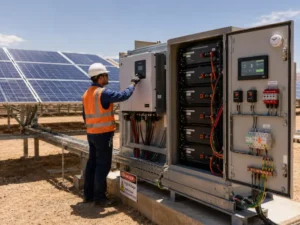
Visiting remote sites for routine inspections can be both time-consuming and expensive. Intelligent monitoring platforms enable operators to supervise battery status, inverter performance, charging behavior, historical energy production, alarm events, and overall system health from a centralized location.
Predictive maintenance based on operational data helps identify abnormalities before failures occur, reducing unexpected downtime and minimizing emergency maintenance visits.
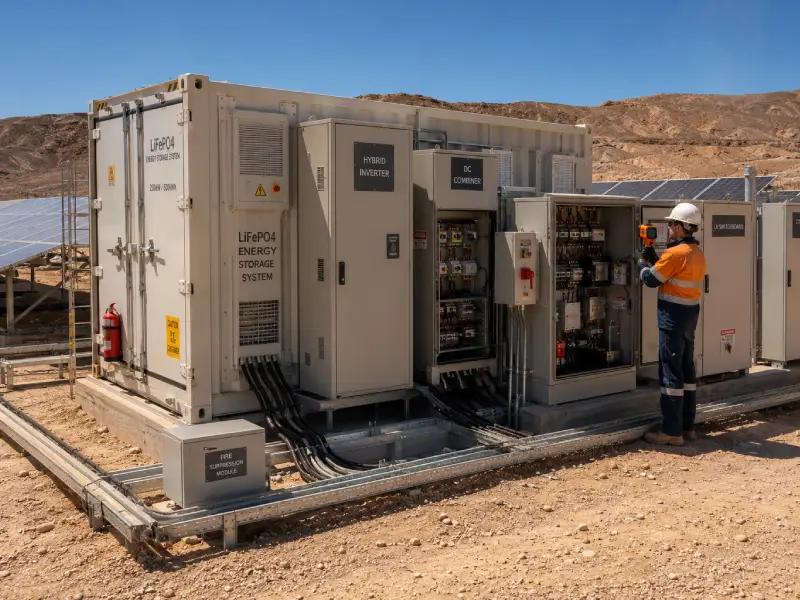
How to Size an Off Grid Remote Solar System for Commercial Applications
Accurate system sizing is one of the most important engineering activities in any off-grid project. Oversized systems increase capital expenditure unnecessarily, while undersized systems may experience frequent battery depletion, reduced equipment lifespan, or insufficient backup during adverse weather conditions.
Professional system sizing follows a structured engineering methodology that balances energy generation, storage capacity, operational requirements, and future scalability.
Step 1 – Calculate Daily Energy Demand
Begin by identifying every electrical load within the project. Record the rated power, expected operating hours, and daily energy consumption for each device.
| Equipment | Rated Power | Operating Hours | Daily Energy |
|---|---|---|---|
| Communication Equipment | 500 W | 24 h | 12.0 kWh |
| LED Lighting | 300 W | 10 h | 3.0 kWh |
| Monitoring Devices | 150 W | 24 h | 3.6 kWh |
| Auxiliary Equipment | 1,000 W | 4 h | 4.0 kWh |
Summing individual loads provides the estimated daily energy demand, which forms the foundation for battery and PV sizing calculations.
Need Help Sizing Your Project?
Accurate battery sizing requires more than calculating daily energy consumption. SolarDyna’s engineering specialists can help evaluate load profiles, backup autonomy requirements, environmental conditions, and future expansion plans to develop a customized off-grid energy solution.
How Much Does an Off Grid Remote Solar System Cost?
One of the first questions procurement managers, EPC contractors, and project developers ask is: “How much does an off grid remote solar system cost?” While this is a reasonable question, there is no universal answer. Unlike standardized residential solar packages, commercial and industrial off-grid systems are custom-engineered according to site conditions, electrical loads, backup requirements, environmental factors, and project objectives.
Rather than focusing solely on initial equipment costs, experienced buyers evaluate projects based on Total Cost of Ownership (TCO). This approach considers not only the purchase price but also installation, maintenance, replacement cycles, fuel savings, operational efficiency, and system lifespan. In many commercial applications, a well-designed off-grid solar system requires a higher upfront investment than a diesel generator but delivers significantly lower operating expenses over its service life.
Key Factors That Influence System Cost
Every off-grid solar project is unique. The following engineering variables have the greatest impact on system pricing:
| Cost Driver | Impact on Project Budget |
|---|---|
| Daily Energy Consumption | Determines PV array size and battery capacity. |
| Peak Power Demand | Influences inverter size and surge capability. |
| Required Backup Days | Additional autonomy increases battery capacity. |
| Local Solar Irradiance | Areas with lower sunlight require larger PV arrays. |
| Environmental Conditions | Corrosion protection, IP rating, and thermal management may increase equipment specifications. |
| Transportation & Installation | Remote locations often increase logistics and commissioning costs. |
| Monitoring & Communication | Cloud monitoring, SCADA integration, and remote diagnostics add system intelligence. |
Instead of asking “What is the price per kilowatt?”, commercial buyers should first define project objectives, expected operating conditions, and long-term energy requirements. A properly engineered proposal provides significantly more value than a generic quotation based only on installed capacity.
Typical Commercial Project Categories
Although exact pricing varies by project, commercial off-grid applications generally fall into several categories:
| Application | Typical Characteristics |
|---|---|
| Telecommunication Stations | Continuous 24/7 operation, relatively stable loads, high reliability requirements. |
| Agricultural Irrigation | Seasonal operation with daytime pumping and optional battery backup. |
| Mining Exploration Camps | Variable loads, modular deployment, portable energy storage. |
| Remote Industrial Facilities | Higher energy demand, redundant power architecture, intelligent monitoring. |
| Island Microgrids | Large battery storage, renewable energy integration, long-term energy independence. |
Expert Tip
For EPC projects, the lowest quotation is rarely the lowest lifecycle cost. Selecting higher-quality batteries, compatible inverters, and integrated monitoring systems often reduces maintenance visits, extends equipment lifespan, and lowers operational expenditure throughout the project lifecycle.
Why LiFePO4 Batteries Are the Preferred Choice for Commercial Off-Grid Solar Systems
Battery storage is the foundation of every commercial off grid remote solar system. While photovoltaic modules generate electricity during daylight hours, batteries ensure uninterrupted power during nighttime operation, cloudy weather, and temporary fluctuations in solar generation. As battery technology has evolved, lithium iron phosphate (LiFePO4) has become the preferred chemistry for modern commercial energy storage because it combines excellent safety, long service life, high efficiency, and low maintenance requirements.
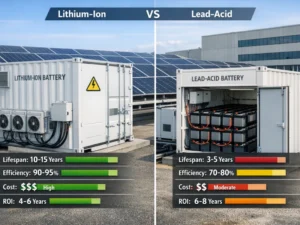
Compared with conventional lead-acid technologies, LiFePO4 batteries deliver significantly more charge-discharge cycles, maintain stable voltage under varying loads, and require little routine maintenance. These characteristics are particularly valuable for remote installations where maintenance visits are expensive and operational continuity is critical.
Long Service Life Reduces Replacement Costs
One of the greatest advantages of LiFePO4 batteries is their long cycle life. Depending on operating conditions, many commercial battery systems are designed to deliver several thousand charge-discharge cycles while maintaining useful capacity. This substantially reduces replacement frequency compared with traditional lead-acid batteries, lowering long-term ownership costs for project owners.
| Battery Technology | Typical Cycle Life* | Maintenance Requirement |
|---|---|---|
| Flooded Lead-Acid | 500–1,200 cycles | High |
| AGM | 500–1,000 cycles | Medium |
| Gel Battery | 800–1,500 cycles | Medium |
| LiFePO₄ | Typically 4,000–8,000+ cycles** | Low |
*Actual service life depends on operating temperature, depth of discharge, charging strategy, and application conditions.
**Values vary among manufacturers and battery designs.
Improved Operational Safety
Safety is a primary consideration in commercial energy storage projects. LiFePO4 chemistry offers greater thermal stability than many other lithium-ion battery chemistries, making it well suited for stationary energy storage applications. When combined with a professionally designed Battery Management System (BMS), the battery pack can continuously monitor voltage, temperature, current, and cell balancing while providing protection against abnormal operating conditions.
For EPC contractors, selecting battery systems with integrated safety features and internationally recognized certifications helps improve project reliability while simplifying compliance with customer specifications.
High Energy Efficiency Improves Solar Utilization
Battery efficiency directly influences how much solar energy can be stored and later delivered to electrical loads. High round-trip efficiency enables a greater proportion of generated solar energy to be used effectively, reducing unnecessary energy losses throughout the charging and discharging process.
For projects with limited roof area or constrained PV installation space, improving battery efficiency can contribute to better overall system performance without increasing the size of the solar array.
Minimal Maintenance for Remote Installations
Maintenance requirements are particularly important for remote infrastructure. Unlike flooded lead-acid batteries that may require periodic inspection and servicing, LiFePO4 batteries are designed for maintenance-friendly operation. When combined with remote monitoring platforms, system operators can evaluate battery status, alarms, state of charge (SOC), and performance trends without frequent site visits.
Engineering Insight
Battery selection should never be based solely on nominal capacity (kWh). EPC engineers should also evaluate usable energy, maximum discharge rate, communication protocols, environmental operating range, enclosure protection level, and compatibility with the inverter and Energy Management System (EMS). These engineering factors often have a greater influence on long-term project performance than battery capacity alone.
Why Commercial Buyers Are Transitioning to LiFePO4
- Lower lifecycle cost despite higher initial investment.
- Long operational lifespan with fewer battery replacements.
- Higher system availability through intelligent battery management.
- Reduced maintenance requirements for remote facilities.
- Excellent compatibility with modern hybrid inverters and EMS platforms.
- Scalable architecture for future energy storage expansion.
Looking for an Engineering-Grade Battery Solution?
SolarDyna provides commercial LiFePO₄ battery systems engineered for demanding off-grid applications, supporting flexible system integration, intelligent monitoring, and scalable energy storage for EPC projects worldwide.
How to Design an Off Grid Remote Solar System for Maximum Reliability
Designing a commercial off grid remote solar system requires far more than selecting solar panels and batteries. Every project must be engineered to deliver stable, uninterrupted electricity under varying environmental conditions while maintaining the lowest possible lifecycle cost. Unlike grid-connected installations, an off-grid system cannot rely on utility power when solar production decreases or unexpected load changes occur. Consequently, engineering decisions made during the design phase directly determine system reliability, operational efficiency, and long-term return on investment.
For EPC contractors, developers, and industrial buyers, a successful project begins with a comprehensive assessment of energy demand, environmental conditions, equipment compatibility, and future expansion requirements. Instead of oversizing every component, professional engineers optimize each subsystem to balance capital expenditure (CAPEX), operating expenditure (OPEX), and system resilience.
Engineering Principle
The most reliable off-grid systems are not necessarily the largest—they are the most accurately engineered. Proper system sizing minimizes unnecessary investment while ensuring sufficient power availability throughout changing weather conditions, seasonal solar variation, and fluctuating electrical loads.
Step 1: Perform a Comprehensive Load Assessment
Every successful project starts with understanding how electricity will be consumed. Load assessment defines the foundation of the entire system design because every major component—including PV modules, batteries, inverters, and backup generators—is sized according to energy demand.
Commercial facilities often operate multiple categories of electrical equipment simultaneously. Engineers should evaluate both continuous consumption and short-duration peak loads to avoid undersized equipment or unnecessary oversizing.
| Load Assessment Item | Engineering Consideration |
|---|---|
| Daily Energy Consumption (kWh) | Determines PV generation and battery storage capacity. |
| Peak Demand (kW) | Defines inverter output power requirements. |
| Motor Starting Current | Requires sufficient inverter surge capability. |
| Operating Schedule | Identifies daytime versus nighttime energy demand. |
| Critical Loads | Determines backup priority during limited energy availability. |
| Future Expansion | Allows scalable system architecture. |
For example, a remote telecommunications station typically maintains a stable 24-hour load, while a mining exploration camp may experience significant fluctuations caused by pumps, compressors, lighting systems, and temporary construction equipment. Understanding these load profiles enables engineers to optimize component sizing while maintaining sufficient operational redundancy.
Step 2: Size the Solar PV Array Correctly
After defining electrical demand, engineers calculate the photovoltaic array required to generate sufficient energy throughout the year. Rather than relying solely on annual average sunlight, professional system designers evaluate seasonal solar irradiation, weather patterns, shading conditions, panel orientation, and expected system losses.
A properly sized solar array should consistently recharge the battery bank while simultaneously supplying daytime electrical loads. Underestimating PV capacity may cause batteries to remain partially charged for extended periods, reducing available backup energy and affecting overall system reliability.
Important design factors include:
- Average peak sun hours throughout the year.
- Seasonal variations in solar radiation.
- Module temperature coefficients.
- Dust accumulation and cleaning intervals.
- Cable and inverter conversion losses.
- Panel degradation over long-term operation.
- Available installation area.
Step 3: Determine Battery Storage and Required Autonomy
Battery capacity determines how long an off grid remote solar system can continue supplying electricity when solar production is unavailable. Required autonomy varies considerably among industries depending on operational risk, weather conditions, and maintenance accessibility.
For example, agricultural irrigation systems may tolerate temporary shutdowns during unfavorable weather, whereas communication towers, emergency infrastructure, security systems, healthcare facilities, and industrial monitoring stations often require continuous operation regardless of environmental conditions.
| Typical Application | Recommended Battery Autonomy |
|---|---|
| Remote Monitoring Equipment | 1–2 days |
| Agricultural Irrigation | 1 day |
| Telecommunication Towers | 2–3 days |
| Mining Camps | 2–4 days |
| Island Microgrids | 3–5 days or more |
Battery sizing should account for usable energy rather than nominal capacity alone. Engineers also evaluate depth of discharge (DoD), charging efficiency, ambient operating temperature, expected battery aging, and future capacity expansion. These considerations help maintain consistent system performance over many years of operation.
Design Recommendation
Instead of designing solely for average weather conditions, commercial projects should include sufficient storage capacity to accommodate several consecutive days of reduced solar generation. This approach significantly improves operational resilience in regions with seasonal rainfall, frequent cloud cover, or unpredictable weather patterns while minimizing the risk of service interruptions.
Step 4: Select the Appropriate Inverter Architecture
The inverter serves as the control center of the entire energy system, converting DC electricity generated by solar modules and batteries into usable AC power for commercial equipment. Beyond power conversion, modern hybrid inverters coordinate charging strategies, battery protection, load management, generator integration, and intelligent energy optimization.
Selecting an inverter based solely on rated output power can result in poor system performance. Commercial projects should evaluate surge capability, conversion efficiency, communication protocols, environmental protection ratings, and compatibility with the Battery Management System (BMS) and Energy Management System (EMS).
| Selection Criterion | Importance |
|---|---|
| Continuous Output Power | Supports total connected load. |
| Peak Surge Capacity | Starts motors and inductive equipment safely. |
| Hybrid Functionality | Supports PV, battery, and generator coordination. |
| Remote Monitoring | Enables diagnostics and predictive maintenance. |
| Scalability | Supports future system expansion. |
| Protection Features | Improves operational safety and equipment longevity. |
Industrial facilities increasingly prefer modular inverter architectures that allow multiple units to operate in parallel. This design improves redundancy, simplifies maintenance, and enables future capacity upgrades without replacing the entire power conversion system.
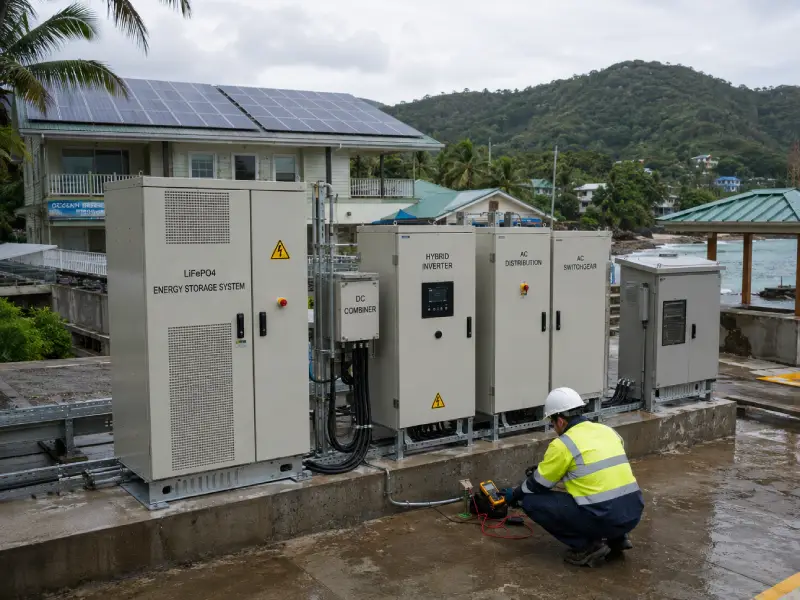
Integrating Backup Generators and Energy Management Systems for Higher Reliability
Even the most carefully engineered off grid remote solar system may experience prolonged periods of unfavorable weather, unexpected load growth, or temporary operational anomalies. For mission-critical commercial applications, combining renewable energy with intelligent backup power significantly improves system availability while maintaining low operating costs.
Modern off-grid power systems are therefore increasingly designed as hybrid energy solutions, integrating photovoltaic generation, LiFePO₄ battery storage, diesel or natural gas generators, and intelligent Energy Management Systems (EMS). Rather than relying on generators as the primary energy source, these systems use them strategically to maximize fuel efficiency and reduce maintenance requirements.
The objective is not simply to provide backup electricity—it is to ensure continuous power with the lowest possible lifecycle cost while minimizing fuel consumption and carbon emissions.
Industry Trend
Many commercial projects are transitioning from diesel-only power generation to renewable hybrid microgrids. By allowing solar energy and battery storage to supply the majority of daily electricity demand, generators operate only when necessary, substantially reducing fuel usage, operating hours, and maintenance expenses.
When Is a Backup Generator Necessary?
Although some small off-grid installations operate entirely on renewable energy, larger commercial and industrial projects often require an additional level of redundancy. Backup generators provide assurance during extended periods of low solar irradiation, emergency situations, or exceptionally high power demand.
Generator integration is particularly valuable when downtime could interrupt business operations, compromise safety, or result in significant financial losses.
| Project Scenario | Generator Recommendation |
|---|---|
| Remote Telecommunication Stations | Recommended for extended cloudy periods. |
| Mining Operations | Strongly recommended for production continuity. |
| Island Microgrids | Provides seasonal energy security. |
| Healthcare Facilities | Critical backup for uninterrupted operation. |
| Agricultural Irrigation | Optional depending on seasonal irrigation schedules. |
| Remote Industrial Sites | Recommended for operational redundancy. |
Instead of operating continuously, hybrid control systems automatically start generators only when battery State of Charge (SOC) falls below predefined thresholds or when instantaneous load exceeds inverter capacity. Once batteries have been sufficiently recharged, the generator shuts down automatically, allowing renewable energy to resume primary operation.
The Role of an Intelligent Energy Management System (EMS)
As commercial energy systems become increasingly sophisticated, intelligent Energy Management Systems have become indispensable. The EMS acts as the central decision-making platform, continuously coordinating power generation, battery charging, electrical loads, and backup generation.
Rather than relying on fixed operating schedules, advanced EMS platforms analyze real-time operating conditions and automatically optimize energy flow according to predefined priorities.
Typical EMS functions include:
- Real-time monitoring of solar generation.
- Battery State of Charge (SOC) management.
- Automatic generator start and stop control.
- Peak load management.
- Remote alarm notifications.
- Historical performance analysis.
- Load prioritization during energy shortages.
- Predictive maintenance support.
Remote Monitoring Improves Operational Efficiency
Remote assets such as telecom towers, pumping stations, weather monitoring facilities, border infrastructure, and mining camps are often located hundreds of kilometers from maintenance personnel. Intelligent cloud monitoring enables operators to supervise multiple installations through a single management platform, improving operational visibility while reducing field service requirements.
| Monitoring Capability | Operational Benefit |
|---|---|
| Battery Status | Identifies abnormal charging or discharge conditions. |
| Solar Production | Detects shading, dirt accumulation, or module degradation. |
| Inverter Performance | Monitors efficiency and fault conditions. |
| Generator Runtime | Optimizes fuel consumption and maintenance schedules. |
| Environmental Data | Supports predictive system analysis. |
| Alarm Notifications | Accelerates troubleshooting and minimizes downtime. |
Many enterprise-level monitoring platforms also provide customizable dashboards, mobile applications, SCADA integration, and API connectivity, enabling EPC contractors and facility owners to consolidate energy data across multiple projects.
Engineering Best Practices for Long-Term Reliability
Reliable system operation depends not only on equipment quality but also on sound engineering practices throughout the project lifecycle. Proper installation, commissioning, monitoring, and preventive maintenance all contribute to maximizing equipment lifespan and minimizing unexpected failures.
Experienced engineering teams generally recommend the following best practices:
- Accurately calculate load profiles before selecting equipment.
- Use compatible components from reputable manufacturers.
- Design adequate battery autonomy for local weather conditions.
- Implement intelligent EMS with automated operating logic.
- Provide remote monitoring for continuous system visibility.
- Allow sufficient room for future expansion.
- Select corrosion-resistant equipment for harsh environments.
- Follow international electrical standards during installation.
- Perform comprehensive commissioning before project handover.
- Establish preventive maintenance schedules supported by performance analytics.
Engineering Insight
The highest-performing commercial off-grid projects are designed with operational flexibility rather than minimum compliance. Modular battery systems, scalable inverter architectures, intelligent EMS platforms, and remote diagnostics provide the adaptability needed to accommodate future energy demand, technology upgrades, and evolving operational requirements without extensive system redesign.
Commercial Applications of Off Grid Remote Solar Systems Across Industries
The versatility of a modern off grid remote solar system extends far beyond isolated residential installations. Today, commercial and industrial organizations across the world rely on off-grid renewable energy solutions to power mission-critical infrastructure where grid electricity is unavailable, unreliable, or economically impractical.
Advances in photovoltaic technology, LiFePO₄ battery storage, intelligent Energy Management Systems (EMS), and remote monitoring platforms have significantly expanded the range of viable applications. From telecommunications and mining to agriculture and island communities, professionally engineered off-grid solar systems provide reliable, sustainable, and cost-effective electricity under challenging operating conditions.
For EPC contractors and project developers, understanding the specific energy requirements of each industry is essential for designing systems that balance performance, reliability, scalability, and long-term operational efficiency.
Market Perspective
Global demand for commercial off-grid solar solutions continues to grow as governments, infrastructure operators, and private enterprises seek cleaner alternatives to diesel generators while expanding access to reliable electricity in remote regions.
Telecommunication Infrastructure
Telecommunication networks require uninterrupted power to maintain voice communication, internet connectivity, and emergency services. Many cellular base stations are located in mountainous regions, deserts, forests, islands, and other locations where extending the electrical grid is either technically difficult or financially unjustifiable.
An off-grid solar system enables continuous operation while dramatically reducing diesel fuel transportation, maintenance visits, and operating expenses.
| Typical Requirements | Engineering Solution |
|---|---|
| 24/7 continuous operation | High-efficiency PV array with LiFePO₄ battery storage. |
| Minimal maintenance | Remote monitoring and predictive diagnostics. |
| Extreme environmental exposure | IP65 enclosures with corrosion-resistant protection. |
| High system availability | Hybrid inverter with automatic generator backup. |
Because network outages directly affect communication services and customer satisfaction, telecom operators generally prioritize redundancy, remote diagnostics, and long battery autonomy during system design.
Mining and Resource Exploration
Mining exploration sites often operate in geographically isolated areas where temporary or mobile power infrastructure is required before permanent facilities are established. Equipment such as drilling rigs, lighting towers, communication systems, laboratories, and worker accommodations all depend on reliable electricity.
Compared with diesel-only generation, hybrid off-grid systems reduce fuel logistics while improving environmental performance and operational sustainability.
- Portable modular battery systems simplify transportation.
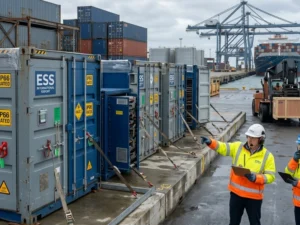
- Containerized energy storage accelerates deployment.
- Hybrid operation minimizes generator runtime.
- Remote monitoring reduces site inspections.
- Expandable architecture supports project growth.
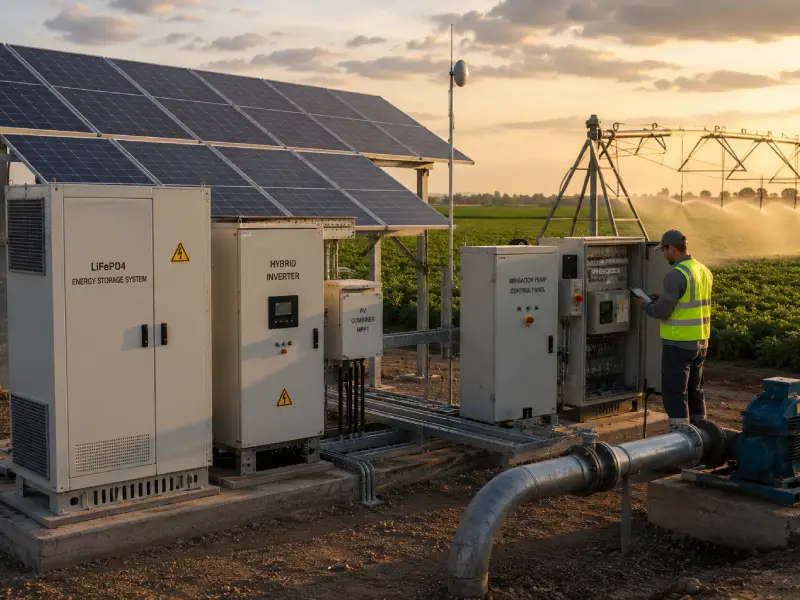
Agricultural Irrigation and Smart Farming
Agricultural operations increasingly utilize renewable energy to power irrigation pumps, water treatment systems, livestock facilities, environmental sensors, and precision farming equipment. Farms located far from utility infrastructure often experience high connection costs, making off-grid solar a financially attractive alternative.
Because irrigation demand typically coincides with daytime solar production, many agricultural projects achieve excellent energy utilization with relatively modest battery storage requirements.
| Agricultural Application | Primary Benefit |
|---|---|
| Water Pumping | Reduces diesel fuel consumption. |
| Livestock Operations | Provides reliable electricity for automated systems. |
| Greenhouses | Supports lighting, ventilation, and climate control. |
| Remote Sensors | Continuous monitoring of crops and soil conditions. |
| Cold Storage | Improves post-harvest product preservation. |
As agriculture becomes increasingly data-driven, integrating solar power with IoT devices and intelligent monitoring platforms enables farmers to improve productivity while lowering energy costs.
Remote Industrial Facilities
Industrial infrastructure such as oil and gas installations, pipeline monitoring stations, border security facilities, environmental monitoring sites, and water treatment plants frequently operate in locations with limited or no utility access.
These applications often require dependable electricity for automation equipment, SCADA systems, instrumentation, security cameras, communication devices, and process control systems. Reliability is therefore a primary engineering objective.
Commercial off-grid systems designed for industrial facilities generally emphasize:
- Industrial-grade components with extended service life.
- Redundant power architecture.
- Advanced EMS integration.
- Remote diagnostics.
- High environmental protection ratings.
- Scalable battery storage.
Island Microgrids and Community Electrification
Remote islands and isolated communities often depend heavily on imported diesel fuel for electricity generation. Fuel transportation costs, supply interruptions, and environmental concerns have encouraged many communities to transition toward renewable hybrid microgrids powered by solar energy and battery storage.
A well-designed off grid remote solar system enables communities to increase energy independence while lowering fuel expenses and reducing greenhouse gas emissions. Intelligent EMS platforms optimize renewable energy utilization, automatically coordinating battery charging and backup generation according to real-time operating conditions.
| Microgrid Benefit | Operational Value |
|---|---|
| Reduced Fuel Imports | Lower long-term operating costs. |
| Energy Independence | Greater resilience against supply disruptions. |
| Lower Carbon Emissions | Supports sustainability objectives. |
| Improved Grid Stability | Consistent power quality through EMS optimization. |
| Scalable Infrastructure | Supports future community development. |
Engineering Insight
Although the operating environments differ significantly, successful commercial off-grid projects share several characteristics: accurate load forecasting, high-quality components, intelligent energy management, remote monitoring capabilities, and sufficient design flexibility to accommodate future expansion. These engineering principles consistently deliver higher reliability and lower lifecycle costs across industries.
Power Your Remote Project with a Tailored Off-Grid Solution
Whether you’re developing a telecom network, mining camp, agricultural project, industrial facility, or island microgrid, SolarDyna provides engineering-grade off-grid solar systems customized for your operational requirements. Our team supports system design, equipment integration, technical consultation, and global project delivery to help you achieve reliable, long-term energy independence.
How to Choose the Right Off-Grid Solar Supplier
Selecting an off-grid solar supplier is one of the most important decisions for EPC contractors, distributors, and commercial project developers. While product specifications and pricing are important, they should be evaluated together with engineering capability, system integration experience, and long-term technical support.
An off-grid solar project is expected to operate reliably for many years under varying environmental conditions. Choosing a supplier that understands complete system design—not just individual components—can help reduce engineering risks, improve installation efficiency, and simplify future maintenance.
The following considerations can help buyers evaluate suppliers more effectively and build long-term partnerships that support sustainable project development.
Evaluate Complete System Integration Capability
A complete off grid solar kit is an integrated energy solution rather than a collection of independent products. Every major component—including photovoltaic modules, battery storage, inverters, charge controllers, and protection devices—must work together as a coordinated system.
When evaluating suppliers, ask whether they can provide complete system integration rather than supplying products individually. A supplier with system-level expertise can recommend compatible components based on project requirements instead of simply offering products from a catalog.
Key questions to consider include:
- Can the supplier provide complete off-grid solar kits instead of separate components?
- Have the solar panels, inverter, battery system, and charge controller been configured to work together?
- Can the supplier recommend system sizing based on actual energy demand?
- Are different configurations available for residential, commercial, and industrial applications?
- Does the supplier understand local installation requirements and environmental conditions?
System integration becomes increasingly important as project size grows. For example, a remote telecommunications station, an agricultural pumping system, and an industrial construction site all require different energy profiles. Although they may use similar equipment, the final configuration should be based on load characteristics, backup requirements, operating schedules, and future expansion plans.
An experienced engineering team evaluates the complete energy flow—from solar generation to battery storage and AC power delivery—to help ensure balanced system performance throughout the project lifecycle.
Review Manufacturing and Quality Standards
Reliable equipment begins with reliable manufacturing processes. Before selecting an off-grid solar supplier, buyers should evaluate not only the finished products but also the quality management practices behind them.
A professional supplier should be able to provide clear documentation regarding product specifications, testing procedures, and applicable certifications. Transparent manufacturing practices help reduce procurement risks and improve confidence in long-term product performance.
Areas worth reviewing include:
- Incoming material inspection procedures.
- Production quality control processes.
- Electrical safety and functional testing before shipment.
- Battery management system (BMS) verification.
- Component traceability and product identification.
- Packaging methods designed to protect equipment during international transportation.
For commercial projects involving multiple installations, product consistency is especially important. Components with stable specifications simplify engineering design, reduce installation adjustments, and improve operational consistency across different project locations.
In addition to manufacturing quality, buyers should verify that products comply with the technical standards required by their target market. Certification requirements vary by country and project type, so discussing compliance early in the procurement process can help avoid delays during installation or project approval.
Look for Long-Term Engineering Support
The relationship between a supplier and an EPC contractor should not end after equipment delivery. Technical communication throughout the project lifecycle can significantly improve installation quality, commissioning efficiency, and long-term system reliability.
Engineering support may include assistance before, during, and after project implementation. Suppliers with experienced technical teams are often better positioned to help customers solve application-specific challenges and optimize system performance.
When comparing suppliers, consider whether they can provide support in areas such as:
- System sizing recommendations.
- Battery capacity calculations.
- Solar array configuration guidance.
- Inverter compatibility verification.
- Electrical wiring recommendations.
- Installation documentation.
- Commissioning support.
- After-sales technical consultation.
Projects installed in remote locations may also require future maintenance planning. Discussing spare parts availability, replacement procedures, and technical documentation during procurement can help reduce downtime if service is required later.
For distributors, long-term engineering support also contributes to stronger customer relationships. Having access to technical expertise allows distributors to respond more effectively to project inquiries while reducing the burden on their internal sales teams.
Why Engineering Teams Choose SolarDyna
Engineering teams are increasingly looking for solution-oriented suppliers that can support complete energy projects instead of simply supplying individual products. SolarDyna focuses on providing integrated off-grid solar solutions that help customers simplify procurement, improve system compatibility, and support reliable project implementation.
Rather than treating solar panels, batteries, inverters, and electrical accessories as separate product categories, SolarDyna approaches each project from a system integration perspective. This engineering-focused methodology helps customers develop solutions that align with their technical objectives and operational requirements.
Integrated Off-Grid Solar Solutions
Every off-grid project has unique operating conditions. Differences in daily energy consumption, installation environments, backup requirements, and available solar resources all influence system configuration.
SolarDyna supports customers by helping configure complete off-grid solar systems that combine compatible components into one coordinated solution.
Typical system configurations may include:
- High-efficiency photovoltaic modules.
- LiFePO4 battery energy storage systems.
- Hybrid or off-grid solar inverters.
- MPPT charge controllers.
- Battery management systems.
- Electrical protection devices.
- Mounting structures and installation accessories.
By evaluating the complete system rather than individual products, engineering teams can simplify procurement and improve overall project consistency.
Customized Support for EPC Contractors and Distributors
Different customers have different technical and commercial requirements. EPC contractors often require project-specific configurations, while distributors may need flexible product combinations to serve multiple market segments.
SolarDyna works closely with partners to understand application requirements before recommending suitable system configurations. This collaborative approach helps customers select solutions that match both technical performance objectives and project budgets.
Support may include:
- Application-based system recommendations.
- Component compatibility evaluation.
- Configuration optimization.
- Technical communication during project planning.
- Documentation support for procurement and installation.
- OEM and private-label cooperation for qualified partners.
This level of collaboration helps reduce engineering uncertainty and supports smoother communication throughout the procurement process.
Reliable Supply for Commercial Solar Projects
Commercial solar projects often involve multiple delivery schedules, standardized equipment specifications, and consistent product quality across different installations. Reliable supply capability therefore becomes an important consideration alongside technical performance.
SolarDyna supports commercial customers by emphasizing product consistency, coordinated system configuration, and responsive technical communication. These factors help customers improve procurement efficiency while reducing project management complexity.
For organizations planning long-term business growth, working with a supplier that understands engineering requirements and values collaborative partnerships can create lasting advantages beyond a single project.
Frequently Asked Questions About Off Grid Remote Solar Systems
Selecting the right off grid remote solar system often involves evaluating technical specifications, project economics, environmental conditions, and long-term operational requirements. Below are some of the questions most frequently asked by EPC contractors, distributors, project developers, and commercial buyers during the procurement process.
1. How long can an off-grid solar system operate without sunlight?
The answer depends on battery storage capacity, daily electricity consumption, and the number of autonomy days designed into the system. Commercial projects are commonly engineered to provide between one and five days of backup power, although critical infrastructure such as telecommunications or island microgrids may require even longer autonomy.
Rather than maximizing battery capacity unnecessarily, engineers typically optimize storage based on local weather data, historical solar irradiation, and project risk analysis.
2. Can an off-grid solar system completely replace a diesel generator?
In many applications, yes. However, for mission-critical industrial facilities, healthcare infrastructure, mining operations, or regions experiencing extended periods of poor weather, a hybrid system that combines solar, LiFePO₄ battery storage, and an automatic backup generator generally provides the highest level of reliability.
This hybrid approach dramatically reduces generator operating hours while maintaining uninterrupted power availability when renewable generation alone is insufficient.
3. What battery technology is recommended for commercial projects?
LiFePO₄ batteries have become the preferred solution for modern commercial off-grid systems because they offer long cycle life, excellent thermal stability, high energy efficiency, and minimal maintenance requirements. Compared with conventional lead-acid batteries, they significantly reduce replacement frequency and lower total lifecycle costs.
When selecting a battery solution, buyers should evaluate more than nominal capacity. Important considerations include usable energy, battery management system (BMS), communication compatibility, operating temperature range, warranty coverage, and certification compliance.
4. How much maintenance does an off-grid solar system require?
Modern commercial systems require relatively little routine maintenance when designed with high-quality components and intelligent monitoring capabilities. Typical maintenance activities include:
- Cleaning photovoltaic modules when necessary.
- Inspecting electrical connections.
- Reviewing battery health through remote monitoring.
- Updating inverter or EMS firmware when applicable.
- Performing scheduled inspections of protection devices.
- Testing backup generator operation for hybrid systems.
Remote monitoring platforms further reduce maintenance costs by enabling operators to detect abnormal operating conditions before they result in equipment failures.
5. Can the system be expanded in the future?
Yes. Most commercial projects are designed using modular architectures that support future expansion. Additional photovoltaic modules, battery storage units, or parallel inverters can often be integrated as electricity demand increases.
Planning for scalability during the initial design phase typically reduces future upgrade costs and minimizes operational disruption.
6. How do environmental conditions affect system design?
Environmental factors play a major role in equipment selection and engineering design. Projects located in coastal areas, deserts, tropical climates, or regions with extreme temperatures require appropriate enclosure protection, corrosion resistance, thermal management, and structural reinforcement.
| Environmental Condition | Recommended Design Consideration |
|---|---|
| Coastal Areas | Marine-grade coatings and corrosion-resistant hardware. |
| High Temperature | Enhanced ventilation and battery thermal management. |
| Heavy Snow | Reinforced mounting structures and optimized tilt angles. |
| Desert Environments | Dust-resistant enclosures and scheduled module cleaning. |
| High Humidity | IP-rated equipment with moisture-resistant components. |
| Strong Wind Regions | Wind-load-certified mounting systems. |
7. What certifications should commercial buyers look for?
Certification requirements vary by country and project type. Commercial buyers typically evaluate compliance with internationally recognized standards covering batteries, inverters, photovoltaic modules, electrical safety, transportation, environmental performance, and grid compatibility where applicable.
Selecting certified products from experienced manufacturers simplifies project approval, improves customer confidence, and supports long-term operational reliability.
Why Partner with SolarDyna for Your Off Grid Remote Solar System?
Choosing the right technology is only part of a successful off-grid project. Equally important is selecting an experienced manufacturing partner capable of providing engineering expertise, quality products, and long-term technical support. For commercial and industrial applications, project success depends on system integration rather than individual components.
SolarDyna delivers complete off-grid solar solutions engineered specifically for demanding environments. Our engineering team works closely with EPC contractors, distributors, developers, and system integrators to design reliable, scalable, and cost-effective energy systems tailored to each project’s operational requirements.
Complete Commercial Energy Solutions
- Commercial and industrial LiFePO₄ battery storage systems.
- Hybrid and off-grid inverter solutions.
- Containerized battery energy storage systems (BESS).
- Integrated Energy Management Systems (EMS).
- Remote monitoring and cloud-based diagnostics.
- Customized engineering and project design support.
- Global logistics and technical documentation.
- OEM and ODM manufacturing services.
Why Commercial Customers Choose SolarDyna
| Capability | Customer Value |
|---|---|
| Engineering-Driven Design | Customized systems optimized for real operating conditions. |
| Scalable Product Portfolio | Supports projects from small remote sites to utility-scale microgrids. |
| High-Quality Components | Improves reliability and extends equipment lifespan. |
| Flexible OEM/ODM Services | Accelerates market entry for distributors and brand owners. |
| Global Technical Support | Assists customers throughout project planning, commissioning, and after-sales service. |
Conclusion
An off grid solar kit is far more than a package of solar panels and batteries. It is a carefully engineered energy system that integrates photovoltaic generation, battery storage, power conversion, electrical protection, and intelligent energy management into a reliable solution for independent power supply.
For EPC contractors, distributors, and commercial project developers, successful projects begin with accurate system planning rather than product selection alone. Evaluating daily energy demand, matching battery capacity with inverter performance, selecting compatible components, and working with an experienced supplier all contribute to better project outcomes and lower lifecycle costs.
As demand for independent energy solutions continues to grow across remote infrastructure, industrial facilities, commercial backup systems, and rural electrification projects, system integration and engineering expertise will become increasingly important purchasing criteria.
SolarDyna is committed to supporting customers with integrated off-grid solar solutions designed around practical application requirements. By combining compatible components with technical consultation and project-oriented configuration support, SolarDyna helps EPC contractors and distribution partners build reliable energy systems for long-term operation.
Planning an Off-Grid Solar Project for a Remote Site?
Build a reliable off grid remote solar system with engineering support from SolarDyna. We provide integrated LiFePO₄ battery storage, hybrid inverters, solar PV systems, and complete off-grid energy solutions for EPC contractors, distributors, telecom operators, mining projects, agricultural facilities, and commercial microgrids.
✔ High-performance LiFePO₄ battery energy storage with intelligent BMS
✔ Customized system sizing, electrical design, and remote monitoring support
✔ OEM/ODM manufacturing with dependable global supply for EPC and distribution partners
Share your load profile, installation environment, and backup requirements to receive a tailored system proposal from our engineering team.
References
The following references provide additional technical guidance on photovoltaic systems, battery energy storage, and engineering best practices. Readers should consult the latest editions or official publications when applying these standards and recommendations to specific projects.
- International Energy Agency. (2024). Renewables 2024: Analysis and Forecast to 2030. Paris, France: IEA.
- International Electrotechnical Commission. (2019). IEC 62446-1: Grid Connected Photovoltaic Systems – Requirements for Testing, Documentation and Maintenance. Geneva, Switzerland: IEC.
- International Electrotechnical Commission. (2021). IEC 62109-1: Safety of Power Converters for Use in Photovoltaic Power Systems. Geneva, Switzerland: IEC.
- National Renewable Energy Laboratory. (2023). Best Practices for Operation and Maintenance of Photovoltaic and Energy Storage Systems. Golden, CO: U.S. Department of Energy.
- U.S. Department of Energy, Solar Energy Technologies Office. (2023). Solar Energy Basics. Washington, DC: U.S. Department of Energy.
- International Renewable Energy Agency. (2022). Electricity Storage and Renewables: Costs and Markets to 2030. Abu Dhabi, United Arab Emirates: IRENA.
Disclaimer: Product configurations, battery capacity, inverter sizing, and engineering recommendations presented in this article are intended as general technical guidance. Actual system design should be based on site conditions, applicable electrical codes, project specifications, and professional engineering evaluation.